Battle of the Pekes and the Pollicles
Old Possum's Book of Practical CatsThe Battle of the Pekes and the Pollicles turns a brief meeting between two dogs into a mass street uproar, then ends it with the sudden appearance of the Great Rumpuscat. Its central reversal is comic and decisive: barking and assembling forces bring traffic to a halt and alarm the neighbours, but one cat’s yawn and leap send the entire crowd scattering. The episode presents a battle in the noisy, exaggerated terms of a comic animal ballad, without describing a physical fight or casualties.
Background and First Encounter
The narrator introduces the incident as something about to be recounted and sets it against a stretch of unusual quiet. Almost nothing has happened for nearly a week, an interval presented as long by the standards of either a Pol or a Peke. The stillness is not explained as the result of a deliberate truce; it is simply the calm against which the chance encounter becomes remarkable.
At the crucial moment, the big Police Dog is away from his beat. The narrator does not know why, while reporting that many people think the dog slipped into the Wellington Arms for a drink. The uncertainty matters: the absence creates an opening for disorder, but its supposed cause remains hearsay rather than an established fact. With nobody about on the street, a Peke and a Pollicle happen to meet.
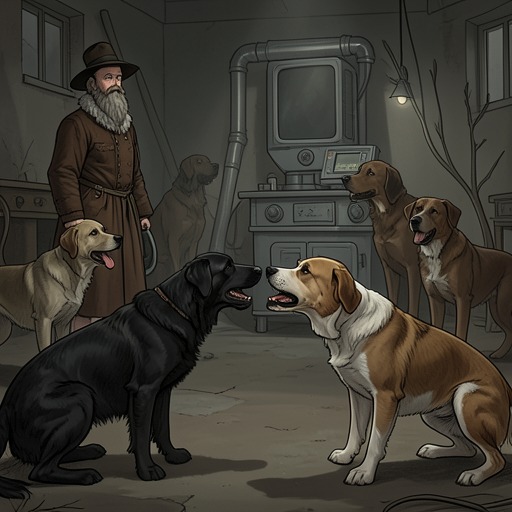
Their first response is neither a direct advance nor a retreat. They glare at each other and scrape their hind feet, a small, suspended exchange that turns immediately into barking. The pause before the noise gives the meeting the shape of a challenge without identifying a specific grievance or showing either dog strike the other. The battle begins as a confrontation in posture and sound.
From Two Dogs to a Crowd
The encounter spreads through the dogs’ respective communities. The account characterizes the Peke as no British dog but a Heathen Chinese dog; when the other Pekes hear the uproar, they gather and grumble and wheeze in what the narrator calls their huffery-snuffery manner. These descriptions give the crowd a deliberately theatrical collective identity, rather than an account of individual participants or a stated political cause for the quarrel.
The Pollicles are described in a contrasting regional register: the Pollicle is a dour Yorkshire tyke, while its braw Scottish cousins are characterized as snappers and biters. They step out together with pipers in order, playing When the Blue Bonnets Came Over the Border. The music makes their arrival a procession as well as a response to the noise. The ballad’s escalating conflict is thus built not just from additional dogs, but from contrasting group labels, an organized entrance, and a musical cue.
The Pugs and Poms, who had until then kept aloof, also join. Some come from a balcony and others from a roof, so the gathering expands vertically as well as across the street. Their arrival completes the shift from a quarrel between two dogs to a spectacle involving several groups. The recurring barking refrain reinforces that growth: the sound carries farther as the crowd grows, until it can be heard all over the Park.
Escalation and Public Alarm
Once the bold heroes have assembled, the disorder affects the surrounding city. Traffic stops, the Underground trembles, and some neighbours become frightened enough to ring up the Fire Brigade. These consequences give the noisy confrontation a scale beyond the dogs themselves: a chance meeting has become a public emergency in the perception of those nearby. The poem’s account makes the escalation vivid through a sequence of effects, while keeping the action focused on barking and gathering rather than depicting a clash of teeth or weapons.
The narrator’s presentation sustains a comic distance from the commotion. The Police Dog’s absence has only a popularly suspected explanation, while the response of the neighbours is rendered through the disproportionate urgency of calling the Fire Brigade. The contrast is between the ordinary, localized beginning—a Peke and a Pollicle meeting in the street—and the increasingly large response around them. Repeated barking links these stages, turning a sound made by two dogs into the signature of a crowd that disrupts traffic and shakes the Underground.
The Great Rumpuscat’s Intervention
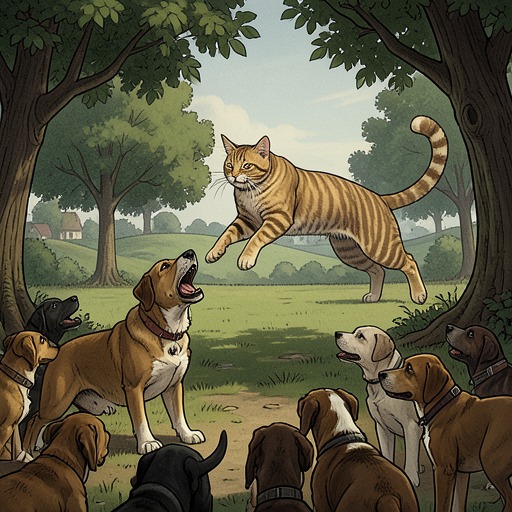
The reversal begins when a figure stalks out from a small basement flat: the Great Rumpuscat. His entrance interrupts the dogs’ collective momentum. His eyes blaze like fireballs; he gives a great yawn, and the account emphasizes the size of his jaws. Seen through the bars of the area, he appears fiercer and hairier than anything the dogs have yet confronted. The scene makes his appearance a striking visual counterweight to the expanding noise outside.
The Great Rumpuscat does not have to fight the assembled dogs. The glare of his eyes and his yawning are enough to put the Pekes and Pollicles on their guard. He then looks at the sky and gives a great leap, and the response is immediate: every last dog scatters like sheep. The buildup has made the crowd seem formidable through its numbers, music, barking, and effects on the city; the swift dispersal makes the cat’s individual presence more effective than the group’s noisy show of force.
Aftermath and Narrative Shape
When the Police Dog returns to his beat, not a single dog is left in the street. His return comes after the resolution rather than causing it. The incident has already ended through the Great Rumpuscat’s intervention, and the empty street provides a compact final measure of the reversal: the very public uproar that stopped traffic and alarmed the neighbours has vanished before the official patrol resumes its place.
The episode’s structure depends on repeated expansion and abrupt release. A quiet week gives way to a meeting; the meeting becomes barking; barking draws in groups and pipers; the crowd produces city-wide disturbance; then the Great Rumpuscat appears, and the dogs scatter. The refrain helps make each increase memorable, while the abrupt ending overturns the apparent balance of numbers. Despite its title, the battle is resolved not by a drawn-out contest between the Pekes and Pollicles but by a comic display of presence that empties the street.